
CRM Vs EHR Systems For Therapists
A CRM for Therapists is designed to streamline and improve efficiency in private practice management. It acts as a central hub for all client information, from contact details and session history to billing records and treatment plans. By keeping everything in one place, therapists can avoid the clutter of spreadsheets, paper files, or multiple disconnected tools.
Automated scheduling is one of the biggest benefits. CRMs send reminders, confirm appointments, and allow clients to reschedule online, reducing no-shows and saving staff time. Payment tracking and invoicing are integrated, so billing becomes faster, more accurate, and less stressful. CRMs also improve client engagement. Automated follow-ups, personalized emails, and text notifications help clients feel supported between sessions. Some platforms even allow therapists to log client progress notes or session highlights, giving a full picture of the client journey.
For multi-therapist practices, CRMs simplify staff coordination. Tasks can be assigned, workflows monitored, and responsibilities tracked. Analytics dashboards provide insights into revenue trends, session frequency, and client retention, helping practice owners make data-driven decisions.
Therapists often juggle multiple responsibilities. CRMs focus on building relationships, managing schedules, and streamlining communication. EHR systems handle clinical documentation and compliance, maintaining detailed records to meet insurance and legal requirements.
Choosing the right system depends on the workflow your practice prioritizes:
CRMs streamline day-to-day operations and improve client engagement.
EHRs secure clinical data and support regulatory requirements.
Some practices benefit from using both, combining workflow efficiency with compliance.
Comparing Features: CRM vs EHR
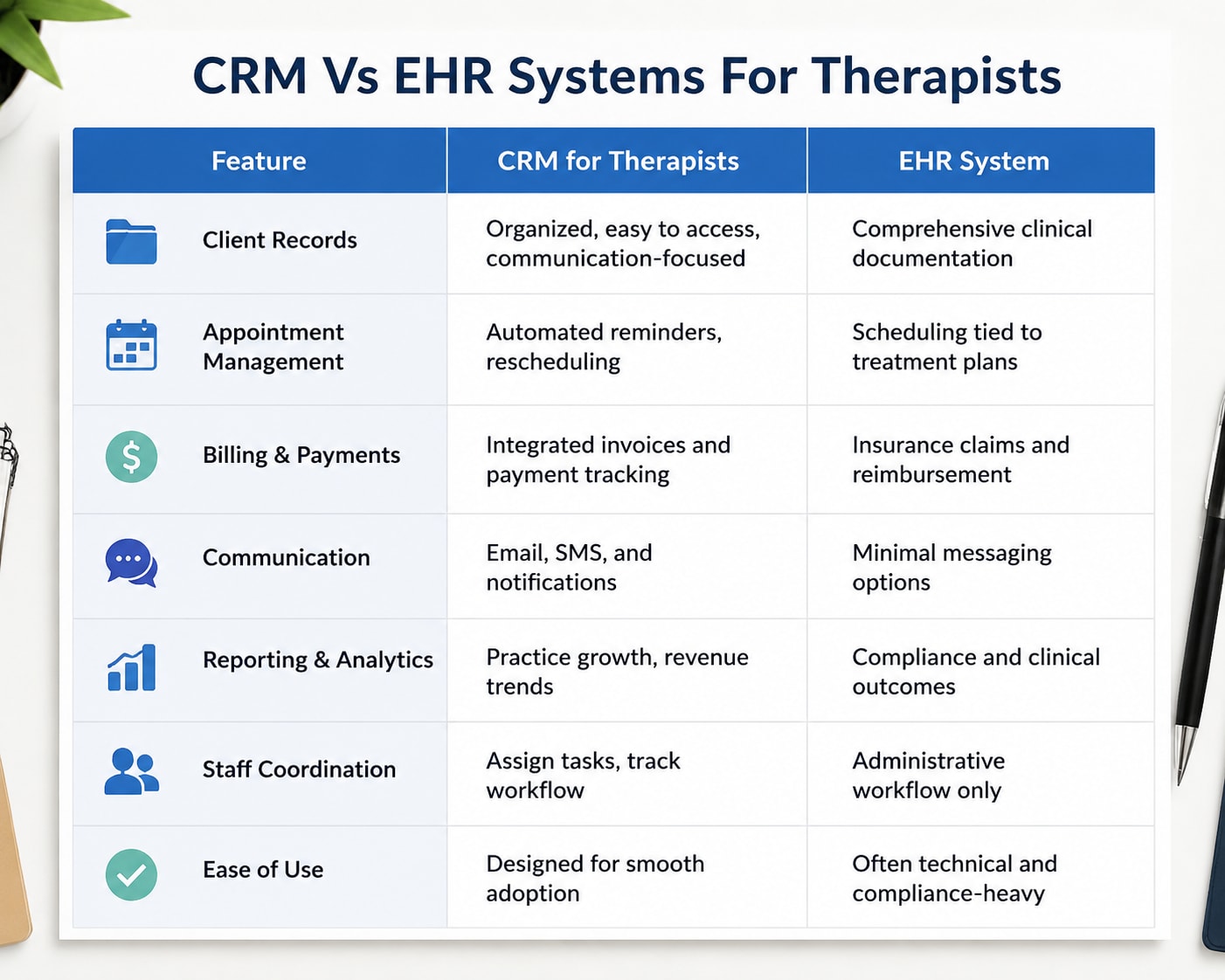
Feature | CRM for Therapists | EHR System |
|---|---|---|
Client Records | Organized, easy to access, communication-focused | Comprehensive clinical documentation |
Appointment Management | Automated reminders, rescheduling | Scheduling tied to treatment plans |
Billing & Payments | Integrated invoices and payment tracking | Insurance claims and reimbursement |
Communication | Email, SMS, and notifications | Minimal messaging options |
Reporting & Analytics | Practice growth, revenue trends | Compliance and clinical outcomes |
Staff Coordination | Assign tasks, track workflow | Administrative workflow only |
Ease of Use | Designed for smooth adoption | Often technical and compliance-heavy |
Benefits of a CRM for Therapists
Reduce missed appointments with automated reminders
Keep client records organized and accessible
Track session trends and practice growth
Assign staff tasks efficiently
Customize workflows to match your practice
A CRM for Therapists also provides actionable insights that help optimize client care, track practice growth, and make informed decisions for long-term success.
Benefits of an EHR System
Maintain HIPAA compliance and insurance standards
Keep detailed treatment notes and patient history
Generate reports for audits or insurance requirements
Secure sensitive clinical data
Integrate with labs, telehealth, and billing services
Popular CRM and EHR Platforms
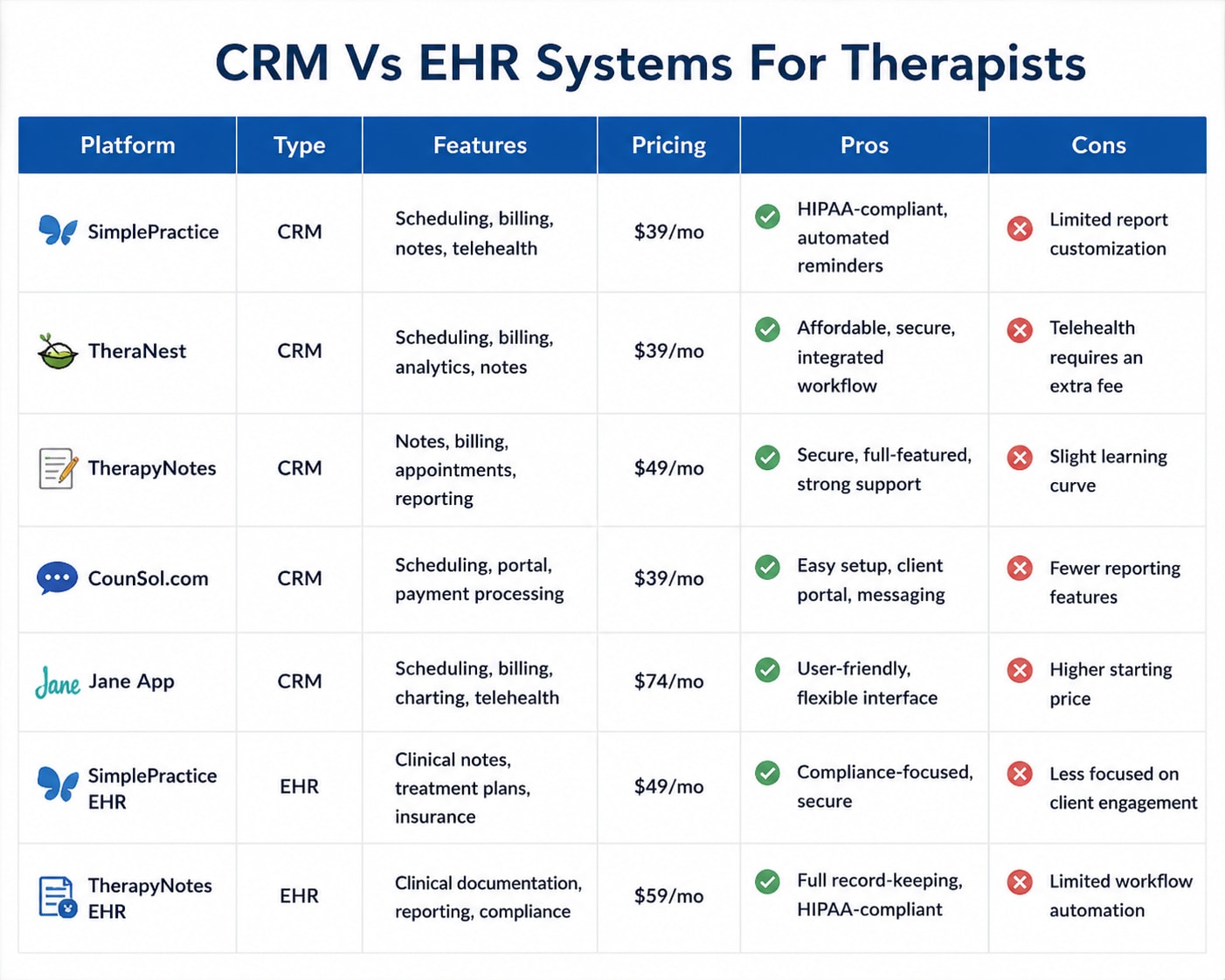
Platform | Type | Features | Pricing | Pros | Cons |
|---|---|---|---|---|---|
SimplePractice | CRM | Scheduling, billing, notes, telehealth | $39/mo | HIPAA-compliant, automated reminders | Limited report customization |
TheraNest | CRM | Scheduling, billing, analytics, notes | $39/mo | Affordable, secure, integrated workflow | Telehealth requires an extra fee |
TherapyNotes | CRM | Notes, billing, appointments, reporting | $49/mo | Secure, full-featured, strong support | Slight learning curve |
CounSol.com | CRM | Scheduling, portal, payment processing | $39/mo | Easy setup, client portal, messaging | Fewer reporting features |
Jane App | CRM | Scheduling, billing, charting, telehealth | $74/mo | User-friendly, flexible interface | Higher starting price |
SimplePractice EHR | EHR | Clinical notes, treatment plans, insurance | $49/mo | Compliance-focused, secure | Less focused on client engagement |
TherapyNotes EHR | EHR | Clinical documentation, reporting, compliance | $59/mo | Full record-keeping, HIPAA-compliant | Limited workflow automation |
Frequently Asked Questions:
Which system is better for small practices?
Small practices often start with a CRM to manage scheduling and communication efficiently. EHRs may be added later for compliance.
Can a CRM track clinical progress?
Some CRMs allow session notes, but EHRs provide detailed clinical documentation needed for insurance or legal purposes.
Is it safe to store patient data in a CRM?
Yes, reliable CRMs comply with HIPAA regulations and encrypt data to ensure security.
Do therapists need both CRM and EHR?
Many growing practices use both: a CRM for workflow and engagement, and an EHR for clinical and billing compliance.
How does a CRM save time?
It automates scheduling, reminders, billing, and communication, letting therapists focus on client care instead of admin work.
Can EHRs replace a CRM?
EHRs focus on records and compliance. They lack workflow automation and client engagement tools that CRMs provide.
Related Posts

Why Therapists Need A HIPAA-Compliant CRM In 2026
Learn why a HIPAA-compliant CRM for therapists is essential. Protect patient data, streamline workflows, and improve practice efficiency safely and securely.

The Importance Of A HIPAA-Compliant CRM For Therapists
Discover why a HIPAA-compliant CRM for therapists is essential. Protect client data, streamline scheduling, billing, and enhance practice efficiency securely.